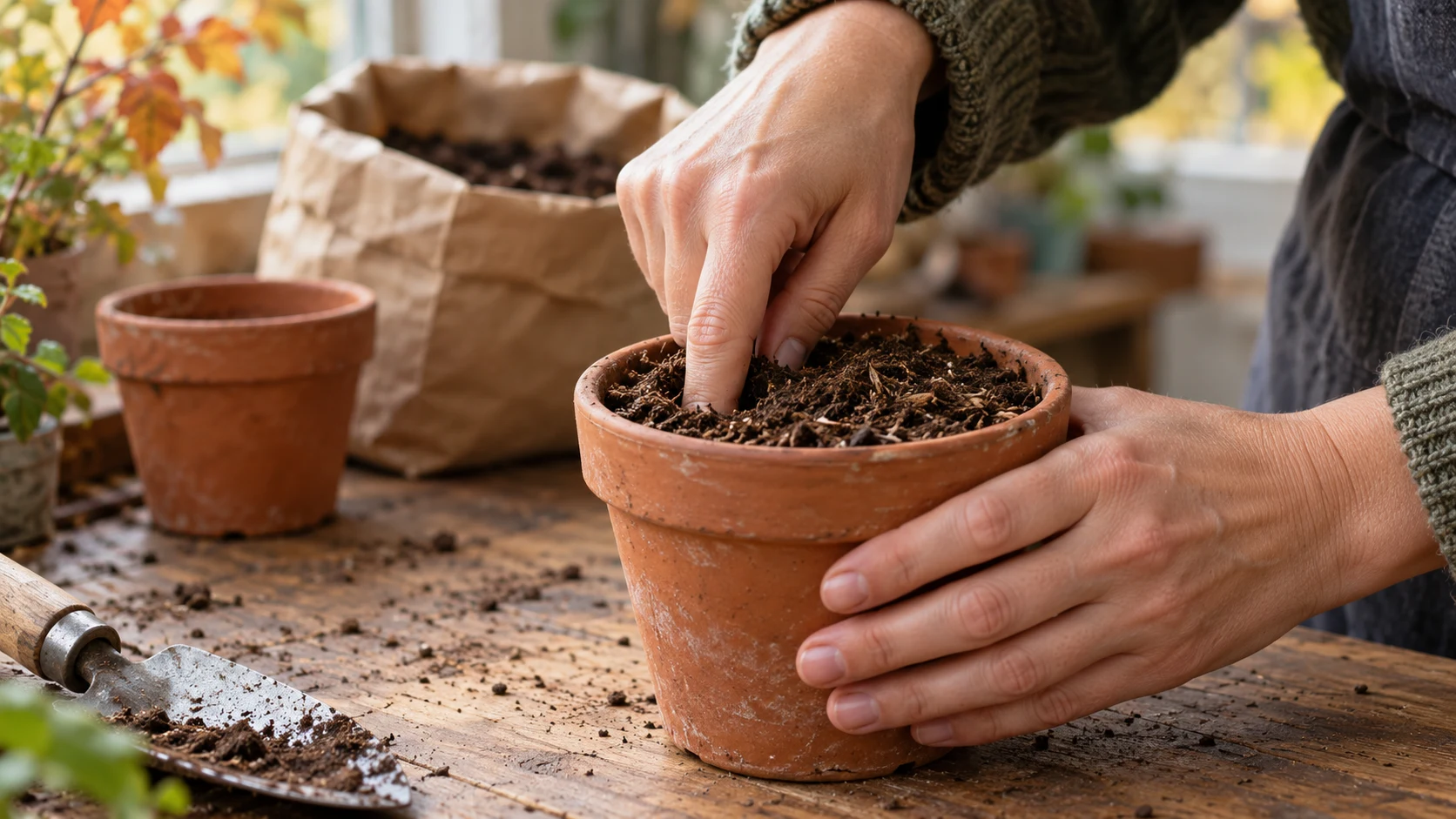
Peat-Free Compost: Choosing a Blend, Watering and Feeding
Choose peat-free compost for the plant and its purpose. Learn how to check moisture, read feeding instructions and avoid unnecessary extra fertiliser.
Choose peat-free compost for the plant and its purpose. Learn how to check moisture, read feeding instructions and avoid unnecessary extra fertiliser.
Quick answer: Late blight shows up as dark, water-soaked patches on leaves and stems that expand within a day or two, often with a thin white fuzz of spores on the underside in humid weather. It’s most common from midsummer through early fall, right after cool, wet stretches. Remove and destroy infected parts immediately, keep…
Quick answer: Start by figuring out whether a weed is annual or perennial — that decision drives your whole strategy. Annual weeds like chickweed and lambsquarters just need pulling or hoeing before they set seed. Perennial weeds like dandelion, quackgrass and bindweed have to come out roots and all, or they regrow from whatever’s left…
Quick answer: Spend at least one full season watching how sun, shade, wind and drainage move across your yard before you dig anything. Then break the space into clear zones — seating, lawn, planting beds, maybe a vegetable patch — and sketch them to scale on paper before buying a single plant. Most home gardens…
Quick answer: Shrink the lawn, group plants into fewer and larger beds instead of scattering small ones, and swap annuals for perennials, shrubs and ground covers that look after themselves once established. Cover every bed with 2–3 in (5–8 cm) of mulch, choose hard surfaces with joints that don’t invite weeds, and let hedges grow…
Quick answer: Composting means mixing nitrogen-rich ”greens” (food scraps, grass clippings) with carbon-rich ”browns” (dry leaves, cardboard, twigs) at roughly one part greens to two or three parts browns by volume. Keep the pile as damp as a wrung-out sponge and turn it regularly. A well-managed hot pile can finish in 2–3 months; a low-maintenance…
Quick answer: Break the space into clear zones instead of showing it all at once, limit yourself to two or three hard-landscaping materials, and choose fewer, larger pots over many small ones. Plant in repeated groups with a restrained colour palette, let greenery soften the boundary, and route paths on a diagonal rather than straight…