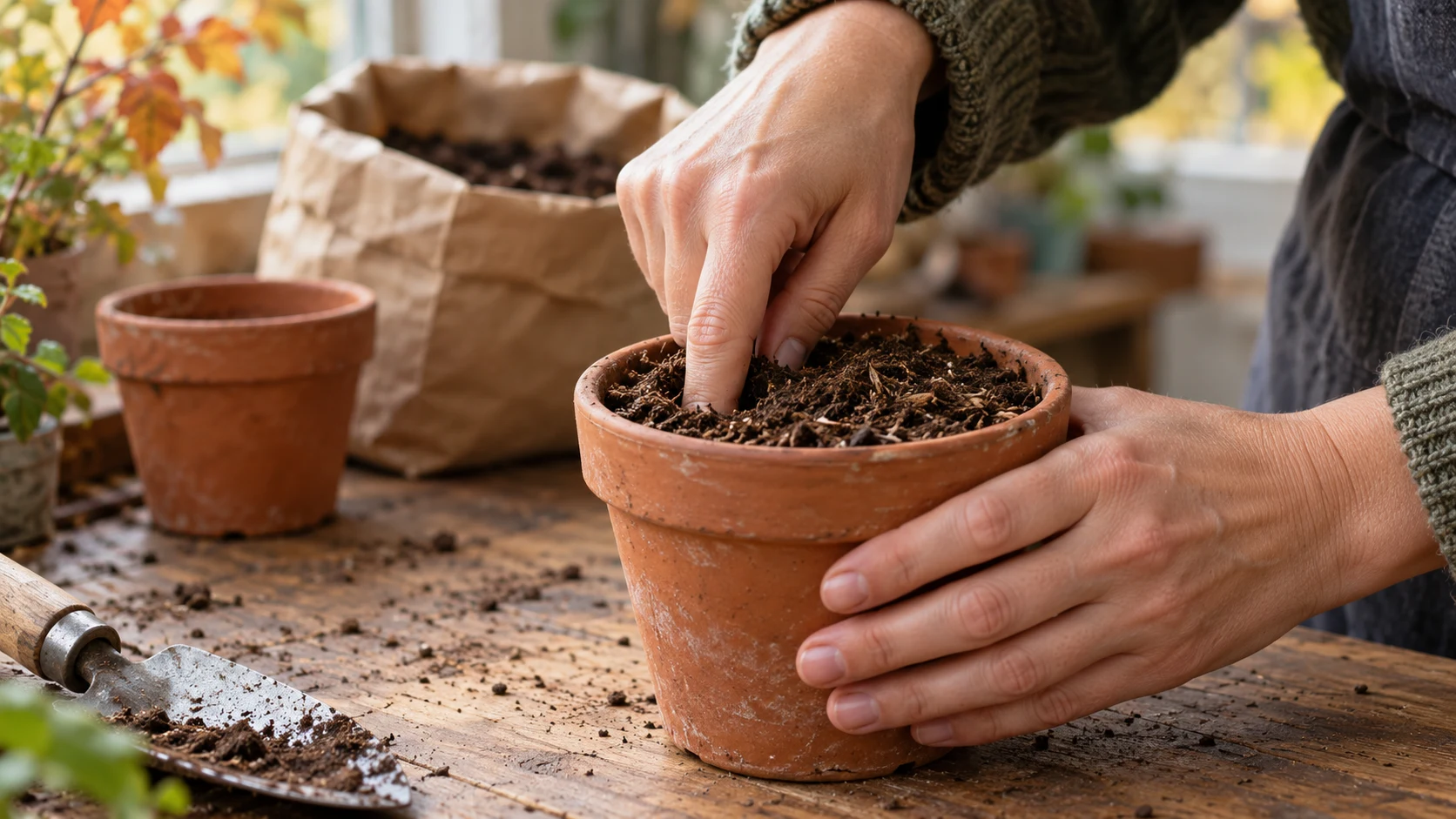
Peat-Free Compost: Choosing a Blend, Watering and Feeding
Choose peat-free compost for the plant and its purpose. Learn how to check moisture, read feeding instructions and avoid unnecessary extra fertiliser.
Choose peat-free compost for the plant and its purpose. Learn how to check moisture, read feeding instructions and avoid unnecessary extra fertiliser.
Quick answer: Shrink the lawn, group plants into fewer and larger beds instead of scattering small ones, and swap annuals for perennials, shrubs and ground covers that look after themselves once established. Cover every bed with 2–3 in (5–8 cm) of mulch, choose hard surfaces with joints that don’t invite weeds, and let hedges grow…
Quick answer: Composting means mixing nitrogen-rich ”greens” (food scraps, grass clippings) with carbon-rich ”browns” (dry leaves, cardboard, twigs) at roughly one part greens to two or three parts browns by volume. Keep the pile as damp as a wrung-out sponge and turn it regularly. A well-managed hot pile can finish in 2–3 months; a low-maintenance…
Quick answer: Break the space into clear zones instead of showing it all at once, limit yourself to two or three hard-landscaping materials, and choose fewer, larger pots over many small ones. Plant in repeated groups with a restrained colour palette, let greenery soften the boundary, and route paths on a diagonal rather than straight…
Quick answer: You can compost most kitchen and garden waste that was once alive — vegetable scraps, coffee grounds, grass clippings, leaves and plain paper. Skip meat, fish, dairy, fat, pet waste from cats and dogs, and diseased plant material. Aim for roughly equal parts ”green” and ”brown” material so the pile stays airy and…
Quick answer: NPK stands for nitrogen (N), phosphorus (P) and potassium (K) — the three nutrients plants need in the largest amounts. The numbers on a bag, such as 12-4-8, show the percentage of each nutrient by weight. Nitrogen builds leaves, phosphorus builds roots and flowers, potassium controls water use and builds resilience. Use a…
Quick answer: Mulching means spreading a layer of material — bark, straw, grass clippings, leaves or compost — over the soil around your plants. The layer holds in moisture, blocks weed seeds from sprouting, and evens out soil temperature swings while slowly breaking down and feeding the soil. Apply 5–10 cm (2–4 in) of organic…