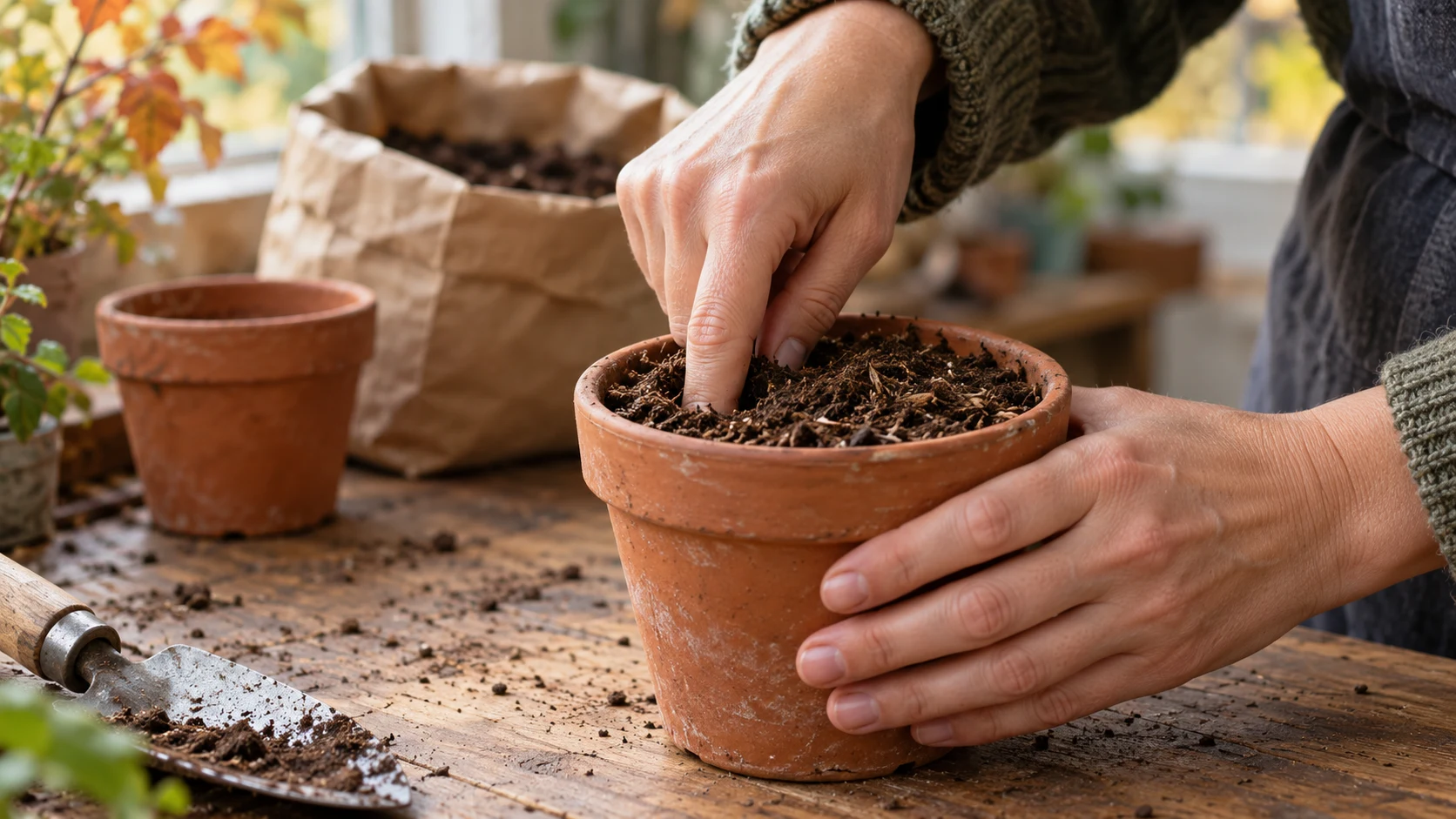
Peat-free compost can work well, but choose the blend for what you want to grow—not just for the words on the bag. Seed compost, potting compost and soil improvers serve different purposes. The most important change is therefore not automatically watering or feeding more, but getting to know the particular blend you use.
Image: AI-generated editorial illustration, not a documented growing trial.
Here we look at what to read on the packaging, how to check moisture and why extra fertiliser is not an automatic solution.
What does peat-free compost mean?
Peat-free means that the blend contains no peat. On its own, that does not tell you which plants it suits, its pH or how long its added nutrients will last. Check the product’s ingredients and intended use.
What we buy in a bag is often a growing medium: a blend designed for the root environment rather than ordinary garden soil. Materials can include wood fibre, coir or mineral components. The blend’s physical, chemical and biological properties need to work together. Two peat-free products will therefore not necessarily behave in the same way.
Why choose alternatives to peat?
Peatlands hold large amounts of carbon. Plant material breaks down slowly in their wet, oxygen-poor conditions. When peatland is drained, oxygen reaches the material, decomposition increases and carbon dioxide is released. This is an important reason for interest in alternatives to peat.
However, peat-free is not the same as a complete environmental declaration. The wording on the bag does not provide a comparable calculation of the finished product’s climate impact. We therefore give no general percentage for climate savings and do not name one blend as the best without product-specific evidence.
Choose the blend for its purpose
- Sowing seeds and taking cuttings: choose a blend intended specifically for seeds or cuttings.
- Repotting: use a suitable potting or planting mix and check which plants it is intended for.
- Plants with particular requirements: look for the appropriate specialist blend, for example for acid-loving plants. A peat-free label does not replace information about pH.
- Borders and soil improvement: distinguish these from growing in pots. Garden compost and leaf mould can be used to improve soil; a ready-made potting mix is not necessarily the right purchase.
To understand the difference between acidic and alkaline growing conditions, read our guide to soil pH. For soil improvement, our composting guide is a better next step than buying more bags of potting compost on a guess.
Water according to moisture—not just the surface
Some peat-free blends look dry on top even while moisture remains further down. Feel beneath the surface before watering. With a small pot, its weight can also help you judge how much water remains.
Do not assume that peat-free compost always needs more water. Follow the plant’s needs and how your particular blend dries out. Read more about watering houseplants if you want to improve your routine.
Does peat-free compost need more fertiliser?
Not automatically. Nutrient needs depend on the blend’s ingredients, the fertiliser already added, the plant and the growing conditions. Read the manufacturer’s information about nutrients already in the product and subsequent feeding.
In British nursery trials involving several peat-free products, more fertiliser did not consistently produce better growth. Excessive applications could instead hinder establishment. The trials covered perennials, shrubs and trees in commercial growing—they do not provide a universal application rate for every plant at home.
We therefore give no general rule that all peat-free compost needs extra nitrogen or liquid feed after a fixed number of weeks. Start with the product instructions, adapt to the plant and avoid adding another dose simply because the compost is peat-free. Our guide to feeding houseplants explores nutrition for plants in pots.
Trees and shrubs: do not fill half the planting hole with bagged compost
When planting in the ground, roots need to establish in the surrounding soil. Loosen a broad area and use the existing soil to backfill. A general mixture of 50 per cent bought-in compost in the planting hole is not our recommendation.
Adding organic material to the bottom does not automatically improve establishment and can cause settlement as it decomposes. Do not plant in frozen or waterlogged ground. Base your approach on the plant and conditions at the site rather than a standard mix for every tree and shrub.
A simple checklist before buying
- Check whether the product is actually peat-free, rather than relying on its other marketing claims.
- Check its intended use, ingredients, pH and feeding instructions.
- Compare the price per litre of products intended for the same job. We have not conducted a current price comparison.
- Note which product you buy, so you can distinguish your own experience of one blend from claims about all peat-free compost.
You do not need to switch to an entirely new care routine at once. Choose an appropriate product, check moisture and follow the feeding instructions. That is more useful than treating every peat-free blend as though it were the same growing medium.