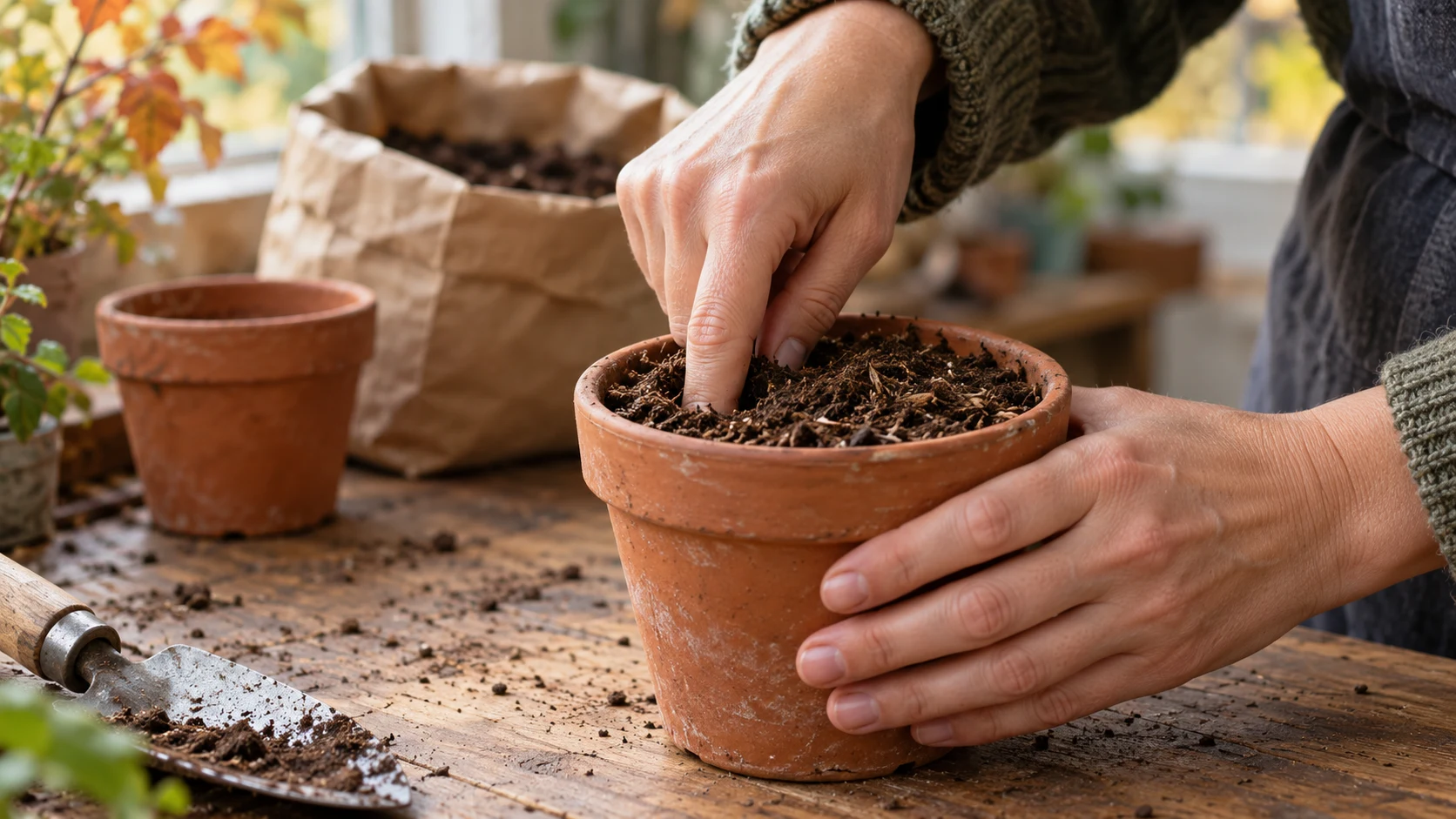
Peat-Free Compost: Choosing a Blend, Watering and Feeding
Choose peat-free compost for the plant and its purpose. Learn how to check moisture, read feeding instructions and avoid unnecessary extra fertiliser.
Choose peat-free compost for the plant and its purpose. Learn how to check moisture, read feeding instructions and avoid unnecessary extra fertiliser.
Quick answer: You can compost most kitchen and garden waste that was once alive — vegetable scraps, coffee grounds, grass clippings, leaves and plain paper. Skip meat, fish, dairy, fat, pet waste from cats and dogs, and diseased plant material. Aim for roughly equal parts ”green” and ”brown” material so the pile stays airy and…
Quick answer: Pelargoniums (often called ”geraniums”) need full sun, watering once the compost dries out, and weekly feeding from spring through midsummer. Bring them in before the first frost and store cool, 40–50°F (5–10°C), somewhere bright if scented or trailing. Water sparingly all winter, cut back to about 4 in (10 cm), and wake plants…
Quick answer: Most houseplants want bright but indirect light, watering only once the top 2-3 cm (about 1 in) of soil has dried out, and feeding roughly every two to four weeks from spring through early autumn. In winter, cut watering back sharply and stop feeding altogether. Overwatering, not poor light, is the single biggest…
Quick answer: Snake plant, ZZ plant, jade plant, pothos and ponytail palm are among the most forgiving houseplants you can buy – they tolerate irregular watering, average light and the occasional missed week without lasting damage. The list below covers 20 easy houseplants grouped by what they’re best at: surviving drought, tolerating low light, flowering…
Quick answer: Snake plant, ZZ plant, pothos and cast iron plant are the toughest low-light houseplants, tolerating as little as 50–100 lux (roughly 5–10 foot-candles). No houseplant survives permanently in a room with zero natural or artificial light — a windowless space needs a grow light running a few hours a day.
Quick answer: Monstera deliciosa wants bright, indirect light, water only when the top 5–7 cm (2–3 in) of soil has dried out, and a chunky, fast-draining potting mix. Feed lightly every 2–4 weeks from spring through summer, repot every 1–2 years, and give the stem something to climb so leaves can develop their signature splits…